
There is a word on this record that doesn't exist anywhere else. Kikagaku Moyo invented "masana" to describe a kind of utopia, a place where everything interacts in harmony and offers inspiration and understanding. We can't think of a better brief for a home, or for a long fall Sunday spent inside one.
Masana Temples came out in 2018, the fourth album from a band that started out busking on the streets of Tokyo in 2012. By the time they made it, the five members had scattered, some across Japan and some to Amsterdam. They regrouped in Lisbon to record at Valentim de Carvalho studio with the Portuguese jazz musician Bruno Pernadas. You can hear both the distance and the reunion in it.
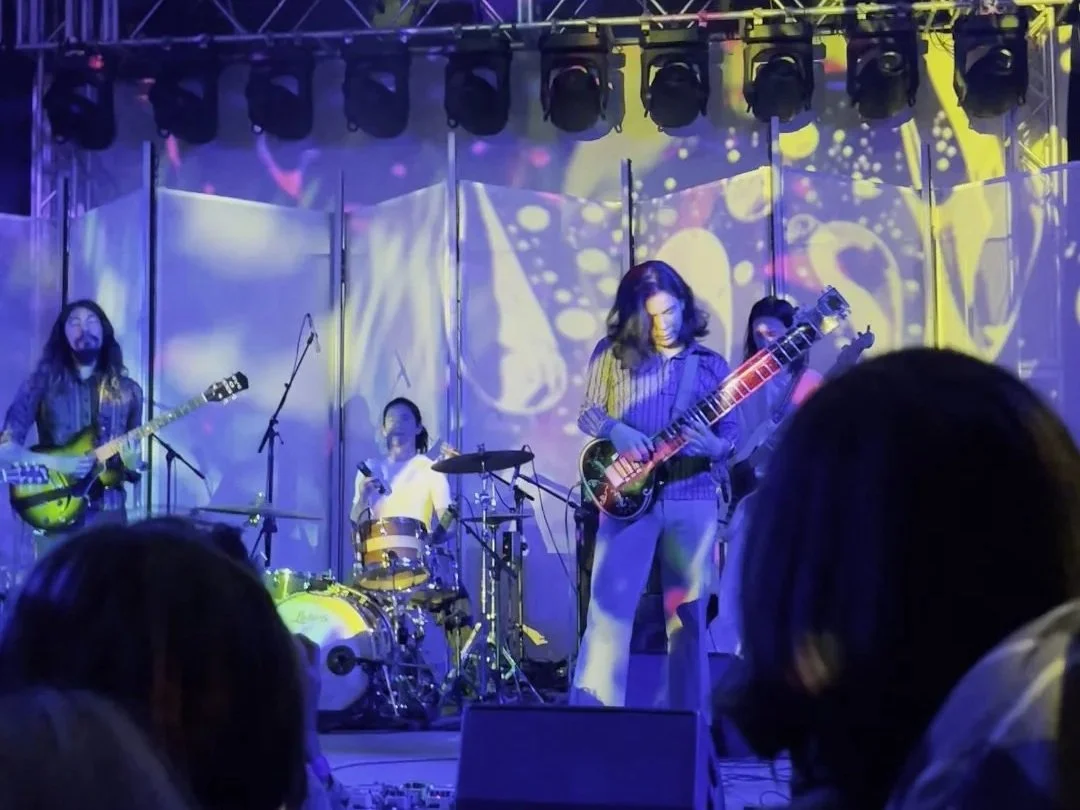
Kikagaku Moyo at Stubbs in Austin, TX, October 2021
How it sounds
The album opens on a sitar, slowly, the way a room fills with morning light. From there it moves through Krautrock pulse, folk, jazz, and something close to lounge, without ever sounding like a genre exercise. Pernadas gave the band room to breathe. The drums sit wide, the guitars wander, and nothing feels crowded.
What we love most is the restraint. The record will settle into a groove so gentle you forget it's playing, then turn on a riff and wake up the whole house. Critics called it the band's most focused work, and they're right, but focus here doesn't mean tight. It means every layer earns its place.
Forty minutes goes by faster than it should.

Kikagaku Moyo at Far Out Lounge in Austin, TX, September 2022
Where to start
Dripping Sun is where to begin. It's the longest track and the heart of the record. Drummer Go Kurosawa described it as a full day: get up, ride a horse, take a walk, explore, go home, and sleep. That's the whole Sunday, in one song.
Nazo Nazo and Gatherings are the other two in heaviest rotation in our studio. Start there if you need convincing.
Once Masana Temples has you, go back to where the band began. Forest of Lost Children came out in 2014, their second album, recorded at Tsubame Studio in Tokyo. It's looser and heavier than what came later, and you can hear a young band finding out what it could do.
Start with Smoke and Mirrors. It opens soft and dreamy, then breaks into dueling guitars and wordless chanting that's hard not to hum along to. Let it run into White Moon, the eight-minute closer, and you'll hear the same patience that made Masana Temples possible four years later.
How to listen
This is a record for a Sunday with nowhere to be. Put it on late in the morning, while the coffee is still warm and the light comes in low and gold, and let it carry you into the afternoon. It belongs in a room with daylight instead of overheads, a deep chair, a cozy throw, and a book you keep setting down. It's the sound of a day that isn't asking anything of you.
Play it on vinyl if you can, and get up to flip the side instead of reaching for your phone. This is music that wants to fill a room, not a pair of earbuds.

Ryu Kurosawa, Sitar Player in Kikagaku Moyo
A band I got to see
I first discovered Kikagaku Moyo when I saw them at Stubb's, opening for The Black Angels in 2021. I saw them again at Far Out Lounge before they ended things, and it was such a bittersweet experience. In 2022 they announced an indefinite hiatus, saying they had achieved their core mission as a band and wanted to end on the highest note possible. Very few bands leave that way, on purpose and at their best.
That makes Masana Temples feel less like an album and more like a place you can go back to. The vinyl is on our list to collect. Until it's on the shelf, we'll keep it playing the digital way.
Listen to Masana Temples on Spotify
Designing for sound
Music changes how a room feels, and a room changes how music sounds. A listening room, a home bar, a cocktail lounge, a recording studio, or a music venue asks for more than a good look. It needs materials chosen for how they hold sound, lighting that sets a mood without announcing itself, and seating that keeps people there long after the last track.
This is some of the work we love most. If you're planning a space built around music, whether it's in your home or for your business, we'd like to hear about it. Reach out through our inquiry form to start the conversation.